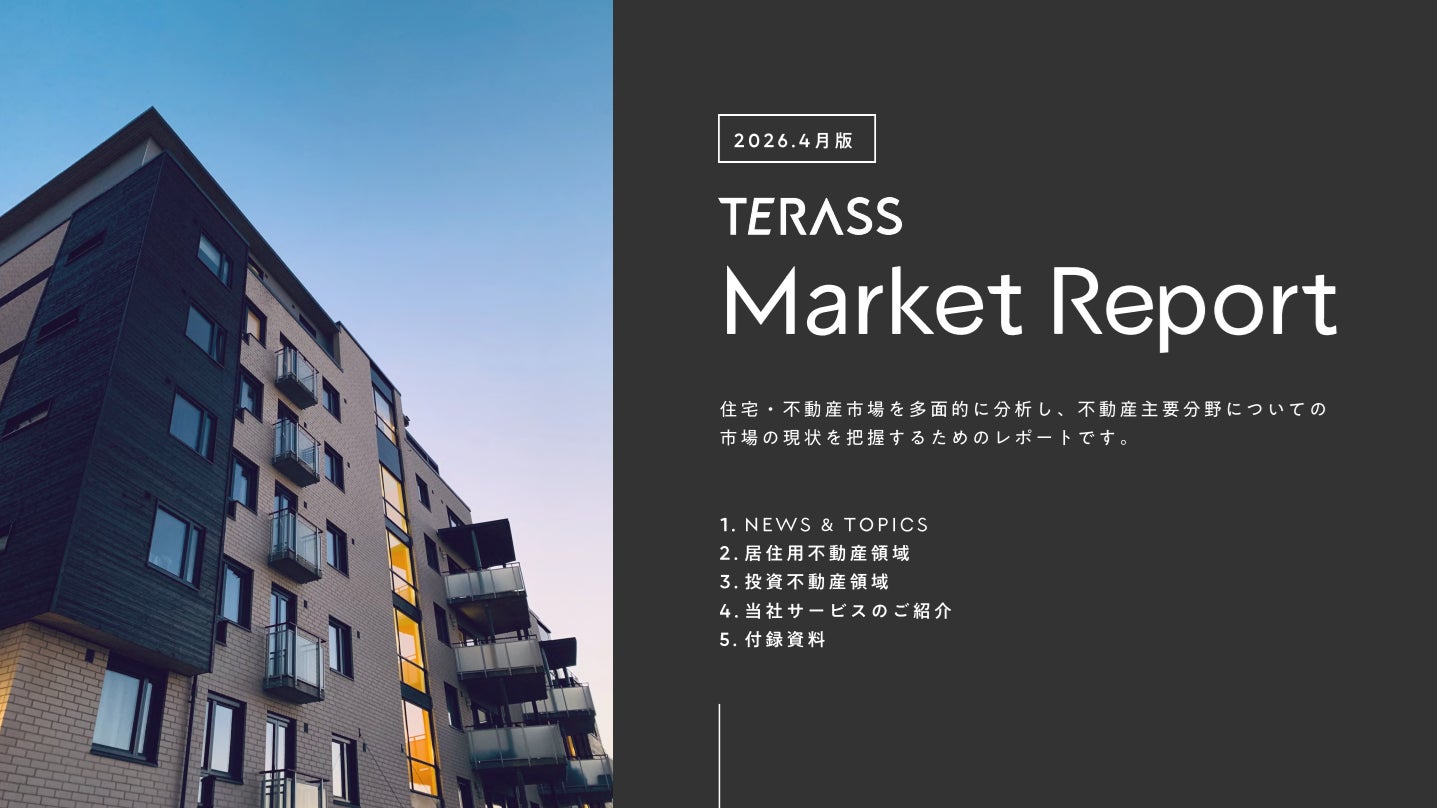
TERASS Market Report Forecasts 2026 as Turning Point for Japanese Real Estate Market
Structured Editorial Report
This report is based on coverage from Prtimes.jp and has been structured for clarity, context, and depth.
Key Points
- TERASS Market Report forecasts a significant "turning point" for the Japanese real estate market in spring 2026.
- The report analyzes trends in both owner-occupied (real demand) and investment (income-generating) properties.
- It includes rankings of popular train stations from both consumer and real estate professional perspectives.
- Specific projections indicate substantial market changes, with figures like 70.487% in 2024, and 102%/353% for 2025/2026.
- The "Terass Offer" initiative, introduced in 2020, is highlighted as a key tool for navigating market changes.
Introduction
TERASS, a prominent real estate data analysis firm, has released its "TERASS Market Report" for April 2026, forecasting a significant "turning point" for the Japanese real estate market in the spring of 2026. This comprehensive report delves into trends affecting both owner-occupied and investment properties, alongside revealing popular station rankings as perceived by both consumers and industry professionals. The analysis suggests that various economic and demographic shifts are converging to reshape market dynamics, prompting a reevaluation of traditional investment and purchasing strategies.
The report, accessible via TERASS's official website, provides detailed insights into the evolving landscape, emphasizing the interplay between supply, demand, and investor sentiment. It serves as a critical resource for stakeholders ranging from individual homebuyers to institutional investors, offering a forward-looking perspective on potential market shifts. The anticipated transition in 2026 is attributed to a confluence of factors, including macroeconomic indicators and changing consumer preferences, which are meticulously examined within the report's findings.
Key Facts
The TERASS Market Report for April 2026 projects a pivotal shift in the real estate market by spring 2026. The report highlights specific timeframes and metrics, indicating a market trajectory from 2024 through 2026. Data points suggest a particular focus on trends observed in 2024, with forward projections extending to the first quarter of 2026. The report references a specific period from 2024 to 2026, indicating a detailed analysis of market evolution over these years.
Key findings include an assessment of real demand and profitable real estate trends, alongside a ranking of popular stations from both consumer and professional perspectives. The report also mentions specific figures related to market performance, such as a 70.487% change observed in 2024, and further projections of 102% and 353% for 2025 and 2026 respectively. These percentages likely refer to growth or change metrics within specific segments of the real estate market, underscoring the dynamic nature of the forecasted period.
Why This Matters
The projected "turning point" in 2026 carries substantial implications for a wide array of stakeholders across Japan's economy. For individual consumers, particularly those considering homeownership or real estate investment, understanding these shifts is crucial for making informed decisions. A market transition could mean changes in property values, mortgage rates, and the availability of desirable properties, directly impacting personal wealth and long-term financial planning. The report's insights into popular station rankings, viewed by both consumers and professionals, could guide residential choices and investment strategies, influencing where people choose to live and where developers choose to build.
For real estate developers, investors, and financial institutions, the report's forecasts are indispensable for strategic planning. Anticipating shifts in demand for owner-occupied versus investment properties allows for more targeted development projects and capital allocation. The potential for significant percentage changes in market segments, as indicated by the report's figures, suggests opportunities for substantial gains or risks of considerable losses, depending on how market participants adapt. This foresight enables businesses to adjust their portfolios, manage risks, and capitalize on emerging trends, thereby influencing the overall health and stability of the real estate sector and, by extension, the broader economy.
Moreover, the report's findings can inform public policy and urban planning. Local governments might leverage this data to anticipate population movements, assess infrastructure needs, and formulate housing policies that align with future market realities. Understanding the factors driving these changes—whether demographic shifts, economic policies, or evolving lifestyle preferences—is essential for fostering sustainable urban development and ensuring equitable access to housing. The report thus serves as a critical barometer for the real estate market, providing a foundation for strategic decision-making at both micro and macro levels.
Full Report
The TERASS Market Report for April 2026, titled "2026 Spring, A Turning Point for Real Estate," elaborates on the intricate dynamics expected to unfold in the Japanese property market. The report emphasizes that the spring of 2026 will mark a significant shift, impacting various facets of real estate. It provides a detailed analysis of both real demand (owner-occupied) and income-generating (investment) properties, offering a dual perspective on market health and future direction. This holistic approach ensures that the report addresses the concerns of diverse market participants, from first-time homebuyers to seasoned institutional investors.
A key component of the report is the ranking of popular train stations, categorized by the perspectives of both general consumers and real estate professionals. This dual ranking system offers unique insights into the perceived value and desirability of locations, highlighting potential discrepancies or convergences in market sentiment. For instance, a station highly rated by professionals might indicate strong investment potential due to development plans or rental yields, while a consumer-preferred station might reflect lifestyle factors such as amenities, school districts, or commute times. These rankings are crucial for understanding localized market trends and identifying areas of future growth or decline.
The report also presents specific data points and projections that underpin its forecast. It references market observations from 2024, indicating a 70.487% change in a particular segment. This figure likely reflects a significant market adjustment or growth rate observed in the recent past, setting the stage for future trends. Looking ahead, the report projects further changes of 102% and 353% for 2025 and 2026, respectively. While the exact metrics these percentages represent are not detailed in the summary, they strongly suggest substantial growth or transformation within specific real estate categories, such as transaction volumes, property values, or investment returns.
Furthermore, the report introduces the "Terass Offer" initiative, highlighting its relevance within the evolving market. The "Terass Offer" appears to be a key service or platform provided by TERASS, designed to navigate the complexities of the current and future real estate landscape. The report mentions its introduction in 2020 and its continued significance, particularly in the context of the anticipated 2026 turning point. This suggests that the "Terass Offer" is integral to how TERASS assists clients in understanding and capitalizing on market opportunities, especially as the market approaches a period of significant change. The report also alludes to future developments related to the "Terass Offer" in 2025, indicating ongoing innovation and adaptation to market needs.
Context & Background
The Japanese real estate market has experienced a complex interplay of factors over the past decade, including demographic shifts, economic policies, and global financial trends. A prolonged period of low-interest rates, coupled with government initiatives aimed at stimulating economic growth, has influenced property values and investment flows. However, Japan's aging population and declining birthrate present unique challenges, impacting long-term housing demand and urban planning. These underlying demographic pressures have created a nuanced market where certain urban centers thrive while rural areas face depopulation, contributing to regional disparities in property values and development.
Recent years have also seen significant foreign investment in Japanese real estate, particularly in major metropolitan areas like Tokyo, Osaka, and Fukuoka, driven by a relatively stable economic environment and attractive yields compared to other global markets. This influx of capital has contributed to rising property prices in prime locations. Concurrently, domestic demand has been influenced by evolving lifestyle preferences, such as a greater emphasis on urban living, access to public transportation, and modern amenities, which in turn shapes the desirability of specific neighborhoods and property types. The market has been in a state of continuous adaptation, responding to both internal and external pressures.
The period leading up to 2026 has been characterized by a gradual recovery from global economic uncertainties and a recalibration of investment strategies. The TERASS Market Report's forecast of a "turning point" in 2026 suggests that the cumulative effects of these various trends—demographic changes, economic policies, and shifting investor behaviors—are converging to create a new market paradigm. This anticipated shift is not an isolated event but rather the culmination of years of underlying developments, necessitating a re-evaluation of established market assumptions and strategies. Understanding this historical context is vital for grasping the significance of the report's forward-looking analysis.
What to Watch Next
As the Japanese real estate market approaches the anticipated "turning point" in spring 2026, several key indicators and developments warrant close monitoring. Stakeholders should pay particular attention to the ongoing releases from TERASS, specifically their subsequent market reports, which will likely provide updated data and refined projections leading up to and beyond 2026. These reports will offer crucial insights into whether the forecasted shifts are materializing as expected and how various market segments are responding.
Furthermore, observe the Japanese government's economic policies, particularly those related to interest rates, housing incentives, and urban development initiatives. Any changes in monetary policy by the Bank of Japan could significantly impact mortgage rates and investment capital flows, directly influencing property affordability and investor sentiment. Additionally, keep an eye on demographic data releases, such as population census updates and migration patterns, as these will confirm or challenge the underlying assumptions driving long-term housing demand. The performance of the "Terass Offer" initiative, as mentioned in the report, will also be a valuable barometer for how industry tools are adapting to and influencing market dynamics.
Source Attribution
This report draws on coverage from Prtimes.jp, specifically the article titled "【2026年4月版 不動産マーケットレポート】2026年春、不動産の『転換点』へーー実需・収益不動産の動向と、生活者・プロから見た人気駅ランキングを公開".
Found this story useful? Share it:
Sources (1)
Prtimes.jp
"【2026年4月版 不動産マーケットレポート】2026年春、不動産の『転換点』へーー実需・収益不動産の動向と、生活者・プロから見た人気駅ランキングを公開"
April 24, 2026