
Philosophical Concept of Emotivism Explored
AI-Summarized Article
ClearWire's AI summarized this story from Existentialcomics.com into a neutral, comprehensive article.
Key Points
- Emotivism is a philosophical theory stating moral talk expresses emotions or attitudes, not objective facts.
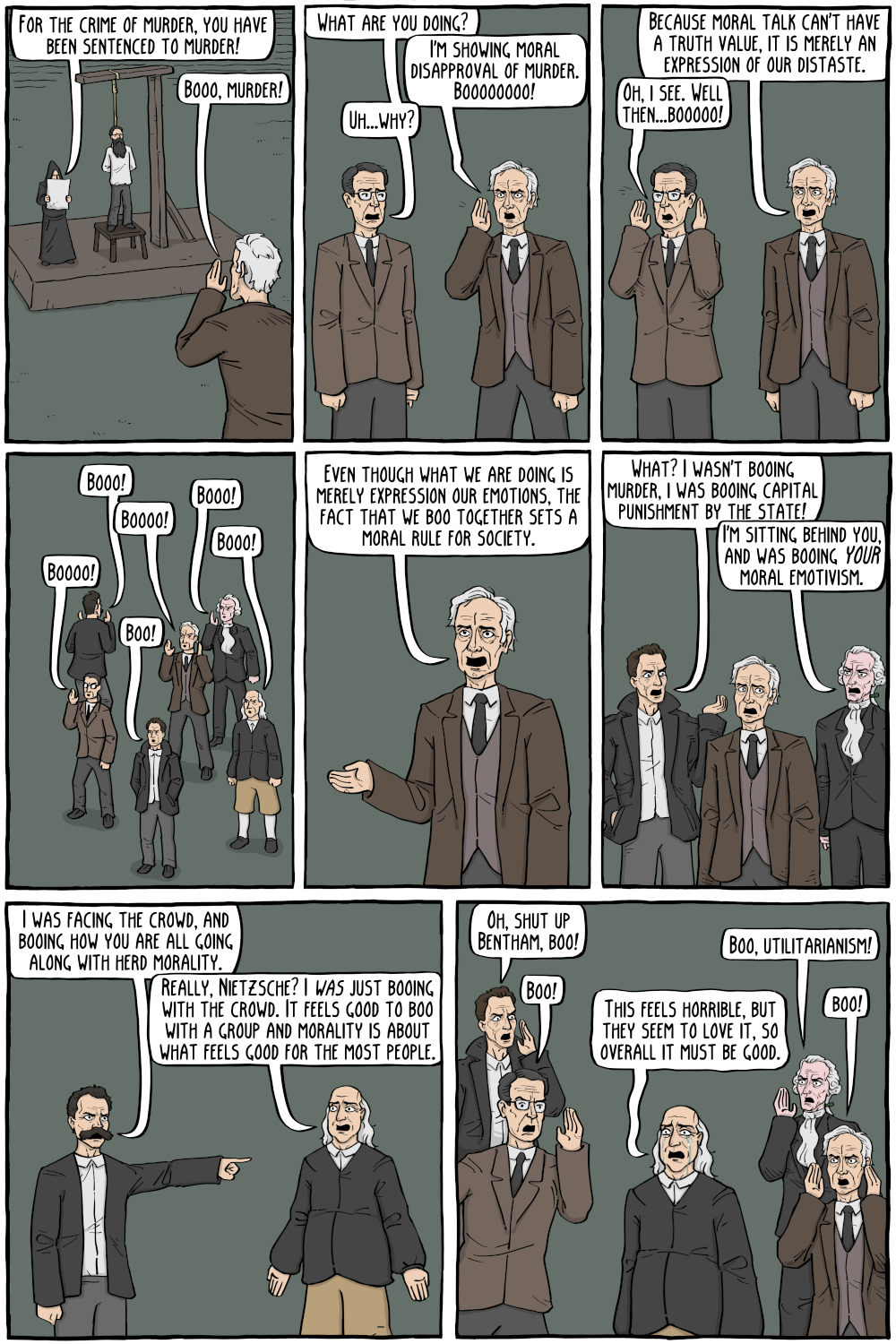
- The theory suggests moral statements, like 'murder is wrong,' are akin to 'boo' or 'hurray,' lacking truth value.
- Prominent proponents like A.J. Ayer and Charles L. Stevenson developed emotivism in the early 20th century.
- Emotivism implies moral language primarily functions to express feelings or influence others' attitudes.
- Critics argue emotivism undermines objective moral reasoning, potentially leading to relativism or nihilism.
- The theory remains relevant in philosophical debates concerning moral truth and the role of emotion in ethics.
Overview
Emotivism, a philosophical theory, posits that moral statements are not factual assertions but rather expressions of emotion or attitude. This perspective suggests that when individuals make moral claims, they are akin to cheering or booing, indicating personal approval or disapproval rather than stating objective truths. Consequently, emotivism argues that moral pronouncements inherently lack a truth value, meaning they cannot be definitively proven true or false. This understanding challenges traditional views of ethics, which often seek to establish universal moral principles.
Background & Context
Originating in the early 20th century, emotivism is closely associated with logical positivism and the verification principle, which held that statements are meaningful only if they can be empirically verified or are analytic truths. Philosophers like A.J. Ayer and Charles L. Stevenson were prominent proponents of this theory. It emerged as a response to the perceived difficulties in grounding moral judgments objectively, particularly in an era emphasizing scientific rigor and empirical evidence. The theory suggests that ethical disagreements are often rooted in conflicting emotional responses or desires rather than rational disputes over facts.
Key Developments
The core tenet of emotivism is that moral utterances serve a non-cognitive function, primarily expressing the speaker's feelings or attempting to influence the listener's attitudes. For instance, saying "murder is wrong" is interpreted not as a statement about an inherent quality of murder, but as an expression of strong disapproval, akin to saying "Boo! Murder!" This implies that moral language is fundamentally persuasive or expressive. It does not describe a state of affairs in the world, but rather conveys subjective sentiments, making moral debates more about influencing behavior and attitudes than discovering objective moral truths.
Perspectives
Emotivism has faced significant criticism for potentially undermining the rational basis of ethics and moral discourse. Critics argue that if moral statements are merely expressions of emotion, then there is no objective ground for moral reasoning, making all moral positions equally valid or invalid. This could lead to moral relativism or nihilism, where ethical debates become intractable and arbitrary. However, proponents maintain that emotivism accurately describes the psychological and social function of moral language, even if it challenges conventional philosophical assumptions about moral objectivity.
What to Watch
Continued philosophical discussions will likely focus on the implications of emotivism for contemporary ethical theory and its role in understanding moral disagreement. Debates surrounding the nature of moral truth, the role of emotion in ethical judgment, and the possibility of objective moral knowledge remain central to philosophical inquiry. The ongoing relevance of emotivism lies in its provocative challenge to how societies and individuals perceive and articulate moral values.
Found this story useful? Share it:
Sources (1)
Existentialcomics.com
"Boo Murder!"
April 13, 2026